

Securing Enterprise Identity Infrastructure Against Modern Cyber Threats
Introduction
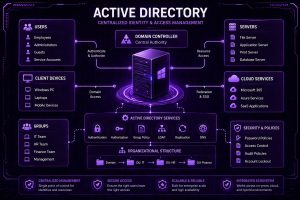
In today’s enterprise environments, Active Directory (AD) serves as the backbone of identity and access management. From employee authentication to authorization and centralized resource management, organizations heavily rely on Active Directory for daily operations. Because of this critical role, cyber attackers frequently target AD infrastructures to gain unauthorized access, escalate privileges, and compromise entire corporate networks.
A single weak configuration or vulnerable service inside an Active Directory environment can provide attackers with a pathway to domain administrator privileges. Once administrative control is achieved, attackers may access sensitive files, deploy ransomware, manipulate security policies, or maintain persistent access inside the organization.
To reduce these risks, organizations conduct Active Directory penetration testing. This offensive security assessment helps identify weaknesses before real attackers exploit them. By simulating realistic attack scenarios, penetration testers evaluate how resilient the AD infrastructure is against modern cyber threats.
This article explores the purpose, methodology, attack techniques, and security considerations involved in professional Active Directory penetration testing.
Understanding Active Directory Penetration Testing
Active Directory penetration testing is a specialized security assessment focused on evaluating the security posture of Windows domain environments. Unlike traditional network penetration testing, AD testing specifically targets identity systems, authentication mechanisms, trust relationships, and access controls.
The primary objective is to determine whether an attacker can:
- Gain unauthorized access
- Escalate privileges
- Move laterally between systems
- Compromise service accounts
- Access sensitive organizational resources
- Obtain domain administrator privileges
Penetration testers simulate real-world attack techniques commonly used by threat actors, ransomware groups, and advanced persistent threats (APTs).

Why Active Directory is a High-Value Target
Most organizations centralize authentication and access management through Active Directory. This means that compromising AD often results in full organizational compromise.
Attackers target Active Directory because it stores:
- User credentials
- Administrative privileges
- Group policies
- Network permissions
- Authentication services
- Domain trust relationships
If attackers successfully compromise the domain controller, they can:
- Disable security controls
- Access confidential data
- Create hidden accounts
- Deploy malware organization-wide
- Maintain persistence for long periods
For this reason, protecting Active Directory has become one of the most important aspects of enterprise cybersecurity.
Objectives of Active Directory Penetration Testing
A professional Active Directory penetration test aims to achieve several security objectives.
Identifying Security Weaknesses
The assessment identifies vulnerabilities, weak configurations, and insecure permissions that could allow unauthorized access.
Testing Authentication Mechanisms
Security professionals evaluate protocols such as:
- Kerberos
- NTLM
- LDAP
- SMB
- DNS
Weaknesses in these services may expose credentials or enable privilege escalation.
Evaluating Privilege Escalation Risks
The test determines whether attackers can move from low-level access to high-privileged administrative accounts.
Assessing Lateral Movement Opportunities
Penetration testers analyze whether compromised systems can be used to move across the network and access additional resources.
Measuring Detection Capabilities
Organizations also assess whether their security monitoring tools can detect malicious activities during simulated attacks.
Scope of an Active Directory Security Assessment
The scope of an Active Directory penetration test depends on organizational requirements and security goals.
Commonly tested components include:
Domain Controllers
Assessment of:
- System configurations
- Patch management
- Kerberos settings
- LDAP security
- Administrative protections
User Accounts and Groups
Evaluation of:
- Password policies
- Privileged accounts
- Service account configurations
- Group memberships
Network Services
Testing:
- SMB shares
- DNS configurations
- Remote Desktop services
- WinRM exposure
- VPN access
Hybrid and Cloud Integrations
Modern environments may also include:
- Azure AD synchronization
- Hybrid identity configurations
- Cloud authentication services
Active Directory Penetration Testing Methodology

A structured methodology ensures accurate and comprehensive security assessment.
The engagement generally includes the following phases:
- Reconnaissance
- Enumeration
- Exploitation
- Privilege Escalation
- Lateral Movement
- Persistence Analysis
- Reporting and Remediation
Reconnaissance Phase
Reconnaissance involves gathering information about the target environment before exploitation begins.
This phase is divided into:
- Human reconnaissance
- Technical reconnaissance
Human Reconnaissance
Attackers often collect publicly available information related to employees and technologies used by the organization.
Common sources include:
- Professional networking platforms
- Public company websites
- Technical forums
- Data breach repositories
- Social media profiles
This information helps identify:
- Employee usernames
- Email naming conventions
- IT administrators
- Technology stacks
- Potential phishing targets
Human reconnaissance increases the effectiveness of password attacks and social engineering attempts.
Technical Reconnaissance

Technical reconnaissance focuses on identifying systems, services, and network architecture.
Penetration testers analyze:
- Open ports
- Operating systems
- SMB services
- LDAP servers
- Kerberos configurations
- Domain information
This phase helps identify:
- Unpatched systems
- Weak protocols
- Legacy services
- Misconfigured authentication settings
The information gathered forms the foundation for exploitation activities.
Black Box Active Directory Penetration Testing
Black box testing simulates an attacker with no valid credentials or internal knowledge of the environment.
The objective is to evaluate whether an external attacker can compromise the domain from an unauthenticated position.
Vulnerability Assessment and Exploitation
Security professionals test for critical Windows vulnerabilities that may expose the domain infrastructure.
Examples include:
- Netlogon vulnerabilities
- SMB-related exploits
- Remote Desktop weaknesses
- Authentication bypass issues
Unpatched systems can allow attackers to execute remote code or compromise domain controllers directly.
Testing Misconfigurations
In many environments, insecure configurations present greater risks than software vulnerabilities.
Common findings include:
- Weak password policies
- SMB signing disabled
- LDAP signing disabled
- Excessive permissions
- Insecure delegation settings
- Anonymous share access
These weaknesses can significantly simplify attacker operations.
Kerberoasting Attacks
Kerberoasting targets service accounts within the domain.
Attackers request Kerberos service tickets and attempt to crack them offline to recover plaintext passwords.
Weak service account passwords often lead to privilege escalation and administrative compromise.
LLMNR and NBT-NS Poisoning
Windows systems frequently use fallback name resolution protocols such as:
- LLMNR
- NBT-NS
- mDNS
Attackers can spoof responses to authentication requests and capture NTLM hashes from victim systems.
Captured hashes may later be cracked or relayed to other services.
Grey Box Active Directory Penetration Testing
Grey box testing simulates an attacker who already possesses valid low-privileged credentials.
This approach is highly realistic because many modern attacks begin with compromised employee accounts.
Enumeration of Domain Objects
With authenticated access, penetration testers enumerate:
- Users
- Groups
- Computers
- Policies
- Trust relationships
- Permissions
This phase identifies privilege escalation opportunities and hidden attack paths.
Privilege Escalation Techniques
Common privilege escalation methods include:
- Weak ACL permissions
- Misconfigured group memberships
- Service account abuse
- Delegation exploitation
- Credential theft
Attackers often chain multiple weaknesses together to obtain domain administrator privileges.
Abuse of Active Directory Permissions
Improperly configured permissions inside Active Directory can allow attackers to:
- Reset passwords
- Modify group memberships
- Control user objects
- Create persistence mechanisms
Even low-level accounts may become dangerous if delegated permissions are misconfigured.
Lateral Movement

Once attackers compromise one system, they attempt to move across the network.
Common lateral movement techniques include:
- Pass-the-Hash
- Pass-the-Ticket
- Remote PowerShell
- SMB execution
- Remote Desktop Protocol (RDP)
Poor network segmentation increases the success rate of these attacks.
Active Directory Certificate Services (AD CS) Exploitation

Misconfigured certificate services can allow attackers to:
- Request unauthorized certificates
- Impersonate privileged users
- Obtain persistent authentication access
AD CS attacks have become increasingly common in modern enterprise intrusions.
Common Security Weaknesses Found During AD Pentesting

During Active Directory security assessments, penetration testers frequently discover:
- Weak or reused passwords
- Overprivileged user accounts
- Unsecured service accounts
- Missing security patches
- Insecure trust relationships
- Misconfigured Group Policy Objects (GPOs)
- Exposed administrative shares
- Lack of multi-factor authentication
- Poor network segmentation
- Inadequate monitoring and logging
Even a small misconfiguration can create serious security risks if attackers successfully chain multiple vulnerabilities together.
Best Practices for Securing Active Directory
Organizations can significantly reduce risks by implementing proper security controls and hardening measures.
Enforce Strong Password Policies
Require:
- Long passwords
- Complex passphrases
- Regular password reviews
- Multi-factor authentication
Apply Security Patches Regularly
Keep:
- Domain controllers
- Windows servers
- Workstations
- Authentication services
updated against known vulnerabilities.
Disable Legacy Protocols
Disable unnecessary and insecure protocols such as:
- SMBv1
- LLMNR
- NBT-NS
This reduces exposure to credential theft and spoofing attacks.
Implement Least Privilege Access
Users should only have the permissions necessary for their roles.
Administrative privileges should be:
- Restricted
- Monitored
- Regularly reviewed
Secure Service Accounts
Use:
- Managed service accounts
- Strong passwords
- Limited permissions
Avoid assigning excessive privileges to service accounts.
Enable Advanced Logging and Monitoring
Organizations should deploy:
- SIEM solutions
- Endpoint detection systems
- Security monitoring tools
Continuous monitoring improves detection of suspicious behavior and privilege escalation attempts.
Segment Internal Networks
Proper network segmentation helps contain attacks and limits lateral movement opportunities.
Critical systems should be isolated from standard user environments whenever possible.
Importance of Regular Active Directory Assessments
Cyber threats continue to evolve rapidly, and attackers constantly develop new techniques to bypass traditional defenses.
A one-time security assessment is not enough.
Organizations should perform regular:
- Active Directory penetration tests
- Vulnerability assessments
- Security audits
- Configuration reviews
Continuous testing helps identify newly introduced vulnerabilities and ensures that security controls remain effective over time.
Conclusion

Active Directory remains one of the most critical and heavily targeted components of enterprise infrastructure. Because it controls authentication, permissions, and access to sensitive organizational resources, a compromise of Active Directory can result in complete network takeover.
Professional Active Directory penetration testing helps organizations proactively identify vulnerabilities, privilege escalation paths, insecure configurations, and authentication weaknesses before attackers exploit them.
By regularly assessing and hardening their AD environments, organizations can significantly reduce the risk of ransomware attacks, credential compromise, insider threats, and domain-wide breaches.
In an era where identity-based attacks continue to rise, securing Active Directory is no longer optional — it is a fundamental requirement of modern cybersecurity.
Secure Your Active Directory Infrastructure with Apprise Cyber

Your Active Directory environment is the foundation of your organization’s digital security. A single weak configuration or exposed credential can lead to unauthorized access, privilege escalation, ransomware deployment, or complete domain compromise.
At Apprise Cyber, we provide professional Active Directory Penetration Testing services designed to uncover hidden vulnerabilities, insecure permissions, authentication weaknesses, and attack paths before cybercriminals can exploit them.
Our cybersecurity experts simulate real-world attack scenarios to help organizations:
- Identify critical security gaps
- Strengthen domain security
- Prevent lateral movement attacks
- Secure privileged accounts
- Improve incident detection capabilities
- Reduce the risk of enterprise compromise
Whether you need black box testing, grey box assessment, internal network security evaluation, or complete Active Directory hardening, our team delivers detailed technical reporting and actionable remediation guidance tailored to your infrastructure.
Protect Your Business Before Attackers Strike
Partner with Apprise Cyber and strengthen your organization’s defense against evolving cyber threats.
📩 Contact us today to schedule a professional Active Directory penetration test and secure your enterprise infrastructure with confidence.