
Smarter, Faster, and Proactive Cyber Defense by Apprise Cyber Security
Introduction
In today’s hyper-connected digital world, cyber threats are no longer simple or predictable. Attackers continuously evolve their techniques using automation, artificial intelligence, and sophisticated evasion strategies. Traditional security tools that rely on static rules and known signatures are struggling to keep up.
This is where AI-powered threat detection becomes a game-changer. At Apprise Cyber Security, we leverage artificial intelligence to help organizations detect, analyze, and stop cyber threats before they turn into costly security incidents.


What Is AI-Powered Threat Detection?
AI-powered threat detection refers to the use of artificial intelligence, machine learning, and behavioral analytics to identify cyber threats in real time. Unlike conventional systems that only recognize known attack patterns, AI-driven solutions learn continuously from data and adapt to new attack methods. These systems analyze massive volumes of information—such as network traffic, user behavior, system logs, and threat intelligence feeds—to identify hidden risks, anomalies, and early indicators of compromise that human analysts or rule-based tools may miss.
Why AI Is Critical for Modern Cybersecurity
Cybersecurity today faces three major challenges: Speed of attacks—Threats spread in seconds Volume of data—millions of events generated daily Complexity of threats—zero-day attacks, polymorphic malware, AI-generated phishing AI addresses all three challenges simultaneously. It processes data at machine speed, learns from patterns, and detects subtle behaviors that indicate malicious activity—enabling organizations to move from reactive security to proactive defense.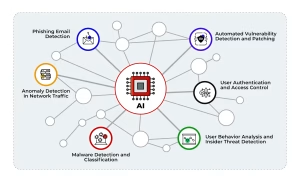
Evolution of Threat Detection: From Rules to Intelligence
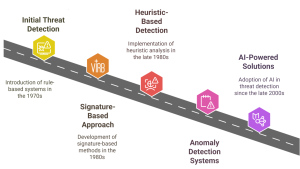
Threat detection has evolved significantly over time:- Rule-Based Systems relied on fixed conditions and known threats
- Signature-Based Detection improved malware identification but failed against new attacks
- Heuristic Methods attempted to detect unknown threats through suspicious behavior
- Anomaly Detection introduced baseline behavior analysis
- AI-Driven Detection now combines automation, learning, prediction, and real-time response
Core Capabilities of AI-Powered Threat Detection
Continuous Learning
AI systems improve over time by learning from new data, incidents, and attacker behavior—making detection more accurate with each cycle. Behavioral Analysis Instead of relying on signatures, AI understands how users, systems, and networks normally behave and flags deviations instantly. High-Speed Data Processing AI analyzes millions of events in real time—something impossible for human teams alone. Predictive Threat Identification By recognizing trends and patterns, AI can forecast potential attacks and help security teams act early. Automated Threat Response AI can trigger predefined actions such as isolating devices, blocking IPs, or alerting security teams—reducing response time dramatically. Reduced False Alerts Advanced models distinguish between legitimate activity and actual threats, minimizing alert fatigue.How AI-Powered Threat Detection Works
At Apprise Cyber Security, AI-driven detection follows a structured process: 1. Data Collection—Network logs, endpoint data, user activity, and external threat intelligence 2. Data Processing – Cleaning, normalization, and feature extraction 3. Model Training—Machine learning models learn from historical and live data 4. Real-Time Monitoring – Continuous analysis of incoming data streams 5. Threat Identification – Detection of anomalies, suspicious patterns, and attack indicators 6. Response & Improvement—Automated or guided response with continuous model updates This cycle ensures that security remains dynamic and future-ready.
Key AI Technologies Used in Threat Detection
- Machine Learning (ML)—Identifies patterns in historical and live data
- Deep Learning—Detects complex attack behaviors across large datasets
- Anomaly Detection Models – Flags unusual activity outside normal baselines
- Natural Language Processing (NLP)—Detects phishing and social engineering attacks
- Predictive Analytics – Anticipates future risks based on trends
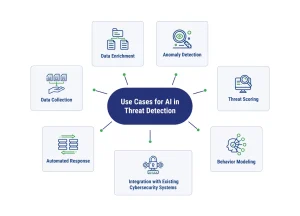
Real-World Applications of AI in Threat Detection
Network Security AI monitors traffic to detect intrusions, data leaks, and lateral movement within networks. Endpoint Protection Endpoints are protected through behavioral monitoring, ransomware detection, and malware prevention.Integration with Existing Security Infrastructure
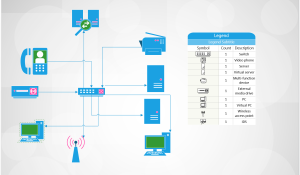
AI does not replace traditional security—it enhances it. Apprise Cyber Security integrates AI-powered detection with:- Firewalls
- IDS/IPS systems
- SIEM platforms
- Endpoint security tools
Ethical Considerations and Responsible AI
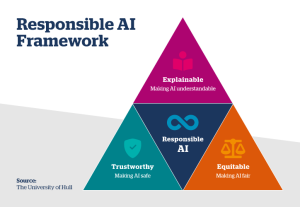
While AI offers immense power, responsible use is essential. Ethical AI practices include:- Data privacy protection
- Bias-free model training
- Transparency in decision-making
- Compliance with global and regional regulations
Future of AI-Powered Threat Detection
The future of threat detection will focus on:- More explainable AI models
- Autonomous incident response
- Stronger predictive intelligence
- Faster processing with advanced computing technologies
Why Choose Apprise Cyber Security?
At Apprise Cyber Security, we combine AI innovation with human expertise to deliver reliable, scalable, and intelligent security solutions. Our AI-powered threat detection helps businesses:- Detect threats earlier
- Reduce breach impact
- Improve operational efficiency
- Strengthen cyber resilience