
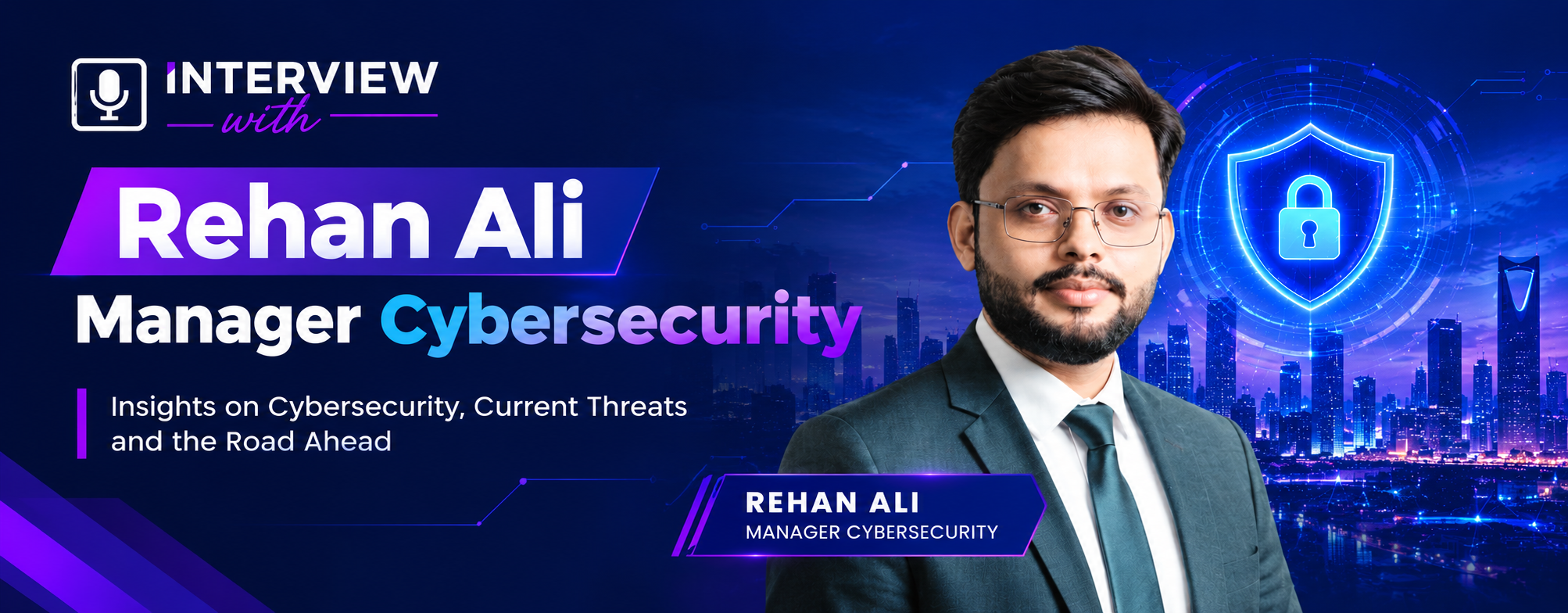
Some people learn cybersecurity from textbooks. Rehan Ali learned it by breaking things ethically. Rehan has more than eight years of experience in penetration testing, vulnerability assessments, and compliance audits. He now leads offensive security operations at Risk Associates across Pakistan, Bangladesh, and the wider EMEA region, covering penetration testing, red-team engagements, and adversary simulations. Before that, he spent more than three years as a Senior Penetration Testing Consultant at Aramco in Saudi Arabia. Earlier roles included Engro Corp, Habib Metropolitan Bank, and Dig8Labs. He holds an MS in Computer Science (Networks and Information Security) and is a CISSP, OSCP, CRTO, CRTP, CARTP, and ISO 27001 Lead Auditor. He has also spoken on “The Art of Breaching”.
In this interview, Rehan discusses:
- The training-lab moment that pushed him into offensive security
- How he tested an industrial drone ecosystem, from firmware and RF signals to GPS spoofing and exposed hardware interfaces
- His red-team toolkit and how he uses Python and PowerShell
- How to explain technical findings in business language that executives can act on
- The three mistakes organizations keep making
- Why AI is a force multiplier for red teams, but not a replacement for human judgment
- His advice for aspiring security professionals in Pakistan and the Middle East
✳️ Career Path and Personal Motivation
Apprise Cyber : What initially inspired you to pursue a career in cybersecurity and ethical hacking?
Rehan Ali : My curiosity sparked my interest in cybersecurity. I found it fascinating to learn how systems work and how they can break.
Apprise Cyber: What experience early in your career led you to specialize in penetration testing?
Rehan Ali : Early on, I simulated an attack during a cybersecurity training lab. I successfully bypassed layered defenses without triggering a single alert. That moment revealed both the challenge and importance of offensive security. It also strengthened my resolve to pursue penetration testing. I saw it as a way to identify and address weaknesses before real threats exploit them.
Apprise Cyber : You have worked in both Pakistan and Saudi Arabia. How would you compare their cybersecurity maturity and threat landscape?
Rehan Ali : Pakistan offers aspiring cybersecurity professionals opportunities to work through diverse, real-world challenges. Limited automation in some environments and hands-on problem-solving can encourage people to learn quickly and think creatively. Saudi Arabia also offers opportunities to work in structured enterprise environments, where regulatory requirements, established processes, and operational scale shape cybersecurity work. The experience in either country depends on the organization, sector, and role.
✳️ Professional Experience and Real-World Engagements
Apprise Cyber: What has been the most technically complex penetration testing engagement you have conducted? What factors contributed to its complexity?
Rehan Ali : I worked on a comprehensive penetration test of an industrial drone ecosystem. It was one of the most technically demanding engagements. The complexity stemmed from its multi-layered architecture:
Embedded Systems
We reverse-engineered firmware running on the flight controller and communication modules. This process required software- and hardware-level analysis skills.
Custom Protocols and Frequencies
The drone operated over proprietary radio frequencies. We analyzed and tested RF security using SDR (Software-Defined Radio) tools. This assessment examined jamming resilience and signal-sniffing risks.
Route Integrity and Tamper Detection
Mission data was stored in the drone and relayed in real time. We tested for:
- Man-in-the-middle (MITM) vulnerabilities
- GPS spoofing
- Potential alteration of telemetry or overrides of automated geofencing
Hardware Interface Testing
JTAG and UART interfaces were exposed, allowing low-level access to onboard components. We assessed physical attack surfaces, including debug ports and unencrypted storage.
Supply Chain Considerations
We evaluated potential backdoors in imported third-party modules used in the build.
Apprise Cyber : How do you approach the security assessment of mobile applications and robotics systems? Consider both architectural and technical perspectives.
Rehan Ali : For mobile and robotics assessments, I begin by reviewing the system architecture. I identify data flows, trust boundaries, and third-party integrations. Technically, I perform:
- Static and dynamic analysis
- API testing
- Firmware review
- Interface fuzzing
The goal is to uncover:
- Logic flaws
- Insecure communications
- Physical attack vectors across system layers
Apprise Cyber : You have experience conducting cloud security assessments. Your work has covered AWS, Azure, and Google Cloud. Which platform presents unique security challenges, and why?
Rehan Ali :Cloud platforms such as AWS, Azure, and Google Cloud Platform (GCP) follow similar architectural patterns and share some security challenges. I have not found one platform to be uniquely more challenging than the others; the risks depend on the services in use, the configuration, and the organization’s security practices.
✳️ Technical and Operational Expertise
Apprise Cyber : What are your preferred tools and frameworks for red teaming? What advantages do they offer?
Rehan Ali :
For red teaming, I rely on flexible toolsets designed for controlled, authorized engagements. Preferred frameworks include:
- Cobalt Strike, Mythic, and Sliver for command-and-control operations
- Empire for PowerShell-based post-exploitation testing
- Caldera for automated adversary emulation
These frameworks offer:
- Modular payload delivery
- Support for operational security (OPSEC) considerations
- Support for custom tactics, techniques, and procedures (TTPs) across engagement phases
Apprise Cyber: How do you leverage scripting languages like Python and PowerShell in your work?
Rehan Ali :
Python and PowerShell are essential during offensive assessments. I use them to build custom tools and automate repetitive tasks.
Python
It is my go-to for:
- Building cross-platform reconnaissance tools
- Parsing scan results
- Automating API-based cloud enumeration
- Developing lightweight command-and-control (C2) implants in authorized testing environments
PowerShell
PowerShell is useful in Windows environments for authorized post-exploitation testing tasks, such as:
- Credential-access testing
- Lateral-movement testing
- Situational awareness
Apprise Cyber : In your view, what is the role of automation in penetration testing today? Could you provide an example where automation significantly improved testing efficiency or results?
Rehan Ali: Automation plays an important role in modern penetration testing. It accelerates reconnaissance, identifies common vulnerabilities, and improves consistency across engagements. It does not replace manual expertise; instead, it frees up time for deeper analysis and more complex testing.
✳️ Compliance, Reporting, and Executive Communication
Apprise Cyber : As an ISO 27001 Lead Auditor, how do you address compliance during red-team activities? How do you ensure these activities align with regulatory and organizational requirements?
Rehan Ali :
I ensure red-team operations align with regulatory and organizational requirements. I embed these activities within the Information Security Management System (ISMS) lifecycle. This includes:
- Scoping assessments to align with the organization’s risk register and security objectives
- Ensuring documented approvals and rules of engagement define legal, ethical, and operational boundaries
- Mapping red-team activities to relevant ISO/IEC 27001:2022 Annex A controls, where applicable. For example, Control 8.8 addresses the management of technical vulnerabilities
- Requiring post-engagement reporting and lessons-learned reviews to support continual improvement and audit readiness
Apprise Cyber : How do you communicate technical vulnerabilities and risk findings effectively? How do you ensure they are clear to non-technical stakeholders and executive leadership?
Rehan Ali : I translate technical findings into business-impact language. This helps me communicate effectively with non-technical stakeholders and executives. I focus on risk, potential operational impact, and alignment with organizational goals.
✳️ Thought Leadership and Professional Advice
Apprise Cyber : What advice would you give to aspiring cybersecurity professionals? Specifically, what guidance would you offer to those in Pakistan and the Middle East? How should those interested in ethical hacking and penetration testing get started?
Rehan Ali :
Start by grounding yourself in the fundamentals:
- Networking
- Linux
- Scripting
Understand how systems truly work. Different environments offer different learning opportunities, from hands-on technical challenges to structured enterprise processes. Use those experiences to build your skills. Stay curious and stay ethical. Your reputation and willingness to learn will open more doors than any toolset alone.
Apprise Cyber : In your talk titled “The Art of Breaching,” you discussed common security mistakes. These lapses increase organizations’ risk of compromise. What are the top three recurring mistakes organizations make?
Rehan Ali :
Organizations usually make these three recurring mistakes:
- Overprivileged Accounts and Flat Privilege Models
System administrators sometimes assign excessive permissions to service accounts, legacy users, and shared credentials. This practice violates the principle of least privilege. Once an attacker gains initial access, excessive permissions can make lateral movement easier.
- Weak Segmentation and Exposure of Internal Tools
Infrastructure may lack proper network segmentation. As a result, critical assets can be accessible from broad IP ranges. Examples include domain controllers and administrative portals. Exposed management interfaces, such as RDP and WinRM, can further increase the attack surface.
- Neglecting Patch Management for Core Services
Administrators may focus on endpoint updates while overlooking core infrastructure components. These can include hypervisors, storage controllers, internal web applications, and VPN appliances. This can leave high-impact vulnerabilities unaddressed.
✳️ Quick Insights (Short-Form Questions)
Apprise Cyber : What is the most common misconception you encounter about cybersecurity?
Rehan Ali : One common misconception is that cybersecurity is purely a technical domain handled only by IT teams. In reality, it is a shared responsibility. Human behavior, organizational culture, and physical security also play important roles. Even strong technical controls can be undermined by a single click on a phishing email.
Apprise Cyber : Which operating system do you prefer for penetration testing, Kali, Parrot, or another? Why do you prefer it?
Rehan Ali : It depends on the scenario.
Apprise Cyber : What is one resource you believe every cybersecurity professional should complete? It could be a book, certification, or training course that you consider essential.
Rehan Ali :
Coding is foundational for working with AI and automation. It allows you to build, understand, and customize tools rather than simply use them. Python is especially useful in both offensive and defensive roles.
For professional development:
- OSCP assesses practical offensive security skills in a hands-on examination
- CC (Certified in Cybersecurity) provides a foundation for newcomers
- CISSP covers security strategy, governance, and risk and may be useful for leadership career paths
A business-focused course can also help bridge technical findings and business decision-making. Examples include SANS SEC566 and training that focuses on incident response and executive reporting.
Apprise Cyber : How do you see the future of red teaming evolving with advancements in AI?
Rehan Ali : AI can speed up discovery and automate pattern recognition. However, sensitive areas, including access credentials, strategic logic, and red-team TTPs, should remain under strict human oversight.
Manual validation helps ensure that context, intent, and ethical boundaries are respected. This is especially important in high-trust or regulated environments. AI is a force multiplier, not a replacement for human intuition, judgment, and responsibility.
✳️ Advanced Assessment Scenarios
Apprise Cyber: How does penetration testing differ between OT (Operational Technology) and IT environments? Please answer particularly in terms of risk and approach.
Rehan Ali : OT testing prioritizes operational safety and uptime, often favoring passive techniques and carefully controlled validation. IT testing may allow more active exploitation, depending on the environment, scope, and acceptable level of risk. Both require defined rules of engagement and safeguards against disruption.
Apprise Cyber: During red-team exercises, how do you simulate real-world adversaries? How do you ensure operational safety for the client throughout these exercises?
Rehan Ali : We simulate adversaries using controlled payloads and defined rules of engagement. Strict monitoring and pre-approved scopes help protect client operations.
Apprise Cyber : What is your methodology for testing APIs? What are the key risks you look for in enterprise-level implementations?
Rehan Ali :
I analyze API architecture, authentication mechanisms, and business logic. Key risks include:
- Broken object-level authorization
- Insecure data exposure
- Excessive permissions
Apprise Cyber : When executing phishing simulations, which metrics do you consider most useful? How do these metrics help evaluate an organization’s preparedness?
Rehan Ali : Click rate, credential-submission rate, and reporting rate are useful indicators. They help assess user awareness, technical controls, and incident-response maturity.
Apprise Cyber : How do you approach vulnerability reporting? How do you ensure that it encourages remediation rather than only documentation?
Rehan Ali : I tie each finding to business impact and provide clear remediation steps. Framing risk in operational language helps gain support from non-technical stakeholders.
Apprise Cyber : Which commercial or open-source security tools do you believe are underutilized? Why do you think they deserve more attention from the industry?
Rehan Ali : Tools such as BloodHound CE, Osmedeus, and pMapper offer useful insights but may be overlooked. Their automation and visibility can make them valuable additions to security workflows.
Apprise Cyber : Suppose clients are hesitant to adopt security recommendations. They may have budgetary or operational constraints. How do you handle such situations?
Rehan Ali : I offer prioritized fixes and lower-cost mitigations, explaining the associated risk trade-offs. Demonstrating return on investment can help shift the discussion from cost to value.
Apprise Cyber : What common architectural flaws do you identify during application security reviews?
Rehan Ali :
Common security weaknesses include:
- Lack of input validation
- Missing access controls
- Insecure direct object references (IDOR)
Many of these weaknesses stem from flawed trust boundaries.
Apprise Cyber : You are a Certified Azure Red Team Professional (CARTP). What cloud-specific risks do organizations tend to underestimate in Microsoft Azure?
Rehan Ali :
Overlooked risks include:
- Misconfigured managed identities
- Overly permissive role-based access control (RBAC)
- Logic Apps configurations that may enable lateral movement
Apprise Cyber : What role should threat intelligence play in shaping proactive cybersecurity strategies?
Rehan Ali : Threat intelligence helps shape red-team objectives and defensive strategy. It aligns these efforts with real-world tactics, techniques, and procedures (TTPs), helping organizations prepare for relevant threats.
✳️ Key Takeaways and Final Thoughts
We thank Rehan Ali for sharing his time and experience with us. His path from hands-on security engineering to leading offensive security across Pakistan, Bangladesh, and the EMEA region shows what curiosity, discipline, and continuous learning can build.
Three lessons stand out from this interview:
- Fix the fundamentals first. Overprivileged accounts, weak network segmentation, and neglected patching on core infrastructure keep opening doors for attackers.
- Speak the language of business. A finding only matters when executives understand the impact and act on it. Tying each issue to operational risk and clear remediation steps turns reports into fixes.
- Use AI as a force multiplier, not a replacement. Automation speeds up discovery, but human judgment, context, and ethics must stay in charge.
His advice to newcomers is simple: build strong foundations in networking, Linux, and scripting, stay curious, and stay ethical. Your reputation and willingness to learn will open more doors than any toolset alone.
At Apprise Cyber, we share this approach. Our team supports penetration testing, red teaming, risk assessments, and ISO 27001 compliance work, with a focus on practical, business-aware security.