

Introduction
For decades, passwords have been the foundation of digital security. From email accounts to enterprise systems, passwords have been used as the primary method to verify user identity. However, as cyber threats have evolved, passwords have increasingly become a liability rather than a safeguard.
Despite complex password policies, regular resets, and multi-factor authentication layers, password-based systems remain vulnerable to phishing, credential theft, brute-force attacks, and human error. Attackers no longer need to “break” passwords — they simply trick users into giving them away.
Passwordless authentication is emerging as a modern, secure alternative. By removing passwords entirely and replacing them with identity-based verification methods, organizations can significantly reduce attack surfaces while improving usability. This blog provides a complete, in-depth guide to passwordless authentication, including how it works, its types, benefits, real-world use cases, and best practices for secure implementation.
Passwordless authentication is transforming digital security by eliminating passwords entirely and replacing them with more secure, user-friendly verification methods. This blog explores what passwordless authentication is, how it works, its benefits, use cases, and how organizations can implement it securely.

What Is Passwordless Authentication?
Passwordless authentication is a security approach that allows users to access systems and applications without creating, remembering, or entering passwords. Instead of relying on shared secrets, authentication is performed using factors that confirm a user’s identity more reliably.
These factors typically fall into three categories:
- Something you have
(trusted device, hardware security key, mobile phone) - Something you are
(fingerprint, facial recognition, biometric identifiers) - Something you do
(approval action, behavioral verification)
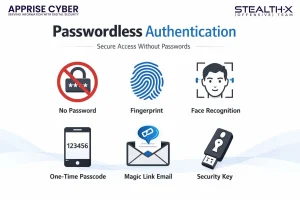
Common passwordless authentication methods include:
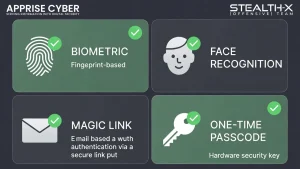
- Biometric authentication (fingerprint or face recognition)
- One-time passcodes (OTP)
- Magic login links
- Hardware security keys
- Push-based authentication via mobile apps
By eliminating passwords, organizations remove one of the most commonly exploited weaknesses in cybersecurity.
How Passwordless Authentication Works
Passwordless authentication relies on cryptographic trust and secure device validation rather than memorized credentials. While implementations vary, the general authentication flow follows these steps:
- Login request initiated
The user attempts to access an application or system. - Verification challenge sent
The system sends a secure authentication request, such as a biometric prompt, OTP, magic link, or push notification. - User identity verified
The user confirms their identity through a trusted device, biometric scan, or approval action. - Access granted securely
Once verified, access is granted without transmitting or storing any passwords.
Because no password exists, attackers cannot steal, guess, reuse, or brute-force credentials — significantly reducing the risk of unauthorized access.

Types of Passwordless Authentication
1. Biometric Authentication
Biometric authentication verifies identity using unique physical characteristics such as fingerprints, facial recognition, or iris scans.
Advantages
- Extremely difficult to replicate
- Fast and seamless user experience
- Widely supported on modern devices
Considerations
- Requires compatible hardware
- Privacy and compliance controls must be enforced
2. Magic Links
Magic links are secure, time-limited URLs sent to a user’s registered email address. Clicking the link authenticates the user automatically.
Advantages
- No password creation or memory required
- Ideal for SaaS platforms and customer portals
- Simple onboarding experience
Considerations
- Depends on email security
- Links must expire quickly to remain secure
3. One-Time Passcodes (OTP)
OTP authentication uses short-lived numeric or alphanumeric codes delivered via SMS, email, or authenticator apps.
Advantages
- Easy to implement
- Works across devices
- Adds a strong verification layer
Considerations
- SMS-based OTPs may be vulnerable to SIM-swap attacks
- Best combined with device trust
4. Hardware Security Keys
Hardware security keys are physical devices (USB or NFC) that authenticate users through cryptographic verification.
Advantages
- Highly resistant to phishing
- No shared secrets
- Ideal for enterprise and high-risk environments
Considerations
- Requires device distribution and management
- Backup options are necessary
5. Push-Based Authentication
Push-based authentication sends a login request to a trusted mobile application, allowing users to approve or deny access in real time.
Advantages
- Real-time security
- Excellent for remote and distributed teams
- Reduces login friction
Considerations
- Requires internet connectivity
- Device security must be maintained
Why Passwords Are No Longer Secure
Passwords fail not because users are careless, but because the model itself is outdated. Modern cyberattacks exploit human behavior rather than technical weaknesses.
Key reasons passwords are ineffective:
- A majority of data breaches involve stolen or reused credentials
- Users reuse passwords across multiple platforms
- Phishing attacks bypass even strong passwords
- Password databases are attractive breach targets
- Credential-stuffing attacks automate large-scale access attempts
Passwordless authentication eliminates these risks by removing passwords entirely from the authentication process.
Benefits of Passwordless Authentication
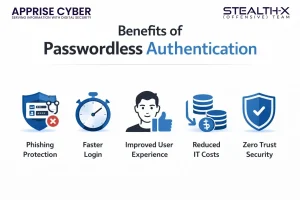
Adopting passwordless authentication delivers measurable security and operational benefits:
- Phishing resistance
No credentials to steal or reuse - Improved user experience
Faster, simpler login processes - Reduced IT workload
Fewer password resets and support tickets - Stronger Zero Trust alignment
Identity-centric access control - Lower breach risk
Smaller attack surface - Compliance support
Helps meet modern security and privacy regulations
Use Cases Across Industries
Passwordless authentication is being adopted across multiple sectors:
- Enterprises
Secure employee access to internal systems and cloud platforms - Banking & Fintech
Prevent account takeover and fraud - Healthcare
Protect sensitive patient data while enabling fast access - E-commerce
Reduce cart abandonment with frictionless login - Remote Workforces
Secure access for distributed teams without VPN dependency
How Businesses Can Implement Passwordless Authentication
Successful implementation requires strategic planning rather than a one-size-fits-all approach.
Step 1: Assess authentication risks
Identify current vulnerabilities and high-risk access points.
Step 2: Select appropriate methods
Choose passwordless technologies based on user roles and threat levels.
Step 3: Integrate with IAM and Zero Trust
Ensure compatibility with identity access management systems.
Step 4: Educate users
Train employees and users to adopt new authentication flows.
Step 5: Monitor and optimize
Continuously audit authentication events and improve controls.
The Future of Authentication
Passwordless authentication is rapidly becoming the global standard. Major technology providers are already supporting passwordless frameworks, and regulatory bodies are encouraging stronger identity verification models.
As digital ecosystems grow more complex, identity-first security will replace password-based access. Organizations that adopt passwordless authentication early gain stronger protection, improved user trust, and long-term resilience.
Passwords are fading — secure digital identity is the future.
Ready to eliminate password-related security risks?
🔐 Let Apprise Cyber help you design and implement secure, modern passwordless authentication solutions tailored to your business.
📩 Contact us today for a professional cybersecurity consultation.