
There are 124 cybersecurity acronyms covered in this list, spanning security roles, certifications, threats, network defenses, cloud tools, compliance laws, and incident-response metrics. This cyber security acronyms list groups each abbreviation by category, with its full form and a fact-based definition, so IT teams, students, and security professionals can find the correct meaning quickly.
What Do Cybersecurity Acronyms Mean?
Cybersecurity acronyms are shortened forms of longer security terms, technologies, laws, and job titles. Security professionals use acronyms such as SOC, MFA, and GDPR to communicate faster across incident reports, compliance documents, and technical tools. “What does cybersecurity stand for?” and “what is the abbreviation for cybersecurity” are common voice search queries for this topic. IT, InfoSec, and CIA (Confidentiality, Integrity, and Availability) are the 3 foundational terms tied to the broader cybersecurity category.
What Are the Common Cybersecurity Job Title and Team Acronyms?
Cybersecurity organizations assign specific acronyms to executive roles and operational teams. There are 14 common role and team acronyms:
| Acronyms | Stands for | Description |
|---|---|---|
| CISO | Chief Information Security Officer | The executive responsible for an organization’s information and data security strategy, including risk, compliance, and security operations budget. |
| CIO | Chief Information Officer | The executive responsible for an organization’s overall IT strategy and information systems. |
| CTO | Chief Technical Officer | The executive responsible for technology strategy, software architecture, and platform decisions. |
| CSO | Chief Security Officer | The executive responsible for both physical and information security, distinct from the CISO’s information-only focus. |
| CTSO | Chief Technical Security Officer | The executive who bridges CISO-level policy with hands-on technical security execution. |
| CPO | Chief Privacy Officer | The executive responsible for developing and enforcing data privacy policies, including GDPR and CCPA compliance. |
| DPO | Data Protection Officer | The role responsible for overseeing data protection strategy; GDPR requires certain organizations to appoint one. |
| SOC | Security Operations Center | A centralized team that monitors, detects, and responds to security incidents using tools such as SIEM platforms. |
| NOC | Network Operations Center | A centralized team that monitors network performance and uptime, distinct from the SOC’s security focus. |
| CERT | Computer Emergency Response Team | A team that handles and coordinates response to cybersecurity incidents, such as US-CERT. |
| CIRT | Cyber Incident Response Team | A group responsible for containment, eradication, recovery, and post-incident analysis after a security event. |
| MSSP | Managed Security Service Provider | A third-party company delivering outsourced 24/7 security monitoring and incident response. |
| MSP | Managed Service Provider | A third-party company that remotely manages a client’s IT infrastructure, including network monitoring and help desk support. |
| MDR | Managed Detection and Response | An outsourced service combining technology with human analysts for continuous threat monitoring, distinct from fully automated MSSP offerings. |
What Are the Key Cybersecurity Certification and Organization Acronyms?
Security certifications and standards bodies validate skills and publish frameworks referenced throughout the industry. There are 22 certification and organization acronyms:
| Acronyms | Stands for | Description |
|---|---|---|
| CISSP | Certified Information Systems Security Professional | A certification issued by (ISC)² covering 8 domains, including security architecture and risk management. |
| CISM | Certified Information Security Manager | An ISACA certification focused on security management and governance for enterprise programs. |
| CEH | Certified Ethical Hacker | An EC-Council certification validating penetration testing and ethical hacking skills. |
| OSCP | Offensive Security Certified Professional | A hands-on certification requiring candidates to compromise systems in a timed lab exam. |
| ECSA | EC-Council Certified Security Analyst | An advanced penetration testing certification focused on methodology-driven testing and reporting. |
| CASP | CompTIA Advanced Security Practitioner | A certification for enterprise-level security practitioners covering risk management and technical integration. |
| SSCP | Systems Security Certified Practitioner | An (ISC)² certification for hands-on IT and security operations roles across 7 domains. |
| GIAC | Global Information Assurance Certification | A certification body validating skills in incident response, penetration testing, and forensics, commonly paired with SANS training. |
| GSEC | GIAC Security Essentials | A GIAC certification validating core security skills for entry-to-intermediate professionals. |
| GCIH | GIAC Certified Incident Handler | A certification validating incident detection, response, and resolution skills. |
| SANS | SysAdmin, Audit, Network, and Security | A training and research organization providing cybersecurity certifications in penetration testing, forensics, and incident handling. |
| ISACA | Information Systems Audit and Control Association | A professional association issuing certifications including CISA, CISM, and CRISC. |
| ISC2 | International Information System Security Certification Consortium | The nonprofit that administers CISSP and other major certifications. |
| CIISec | Chartered Institute of Information Security | A UK professional body accrediting information security careers from entry-level to chartered status. |
| NIST | National Institute of Standards and Technology | A US federal agency that publishes cybersecurity standards, including the NIST Cybersecurity Framework. |
| ISO | International Organization for Standardization | A global standards body that publishes ISO/IEC 27001 for information security management. |
| CIS | Center for Internet Security | A nonprofit publishing security benchmarks, including the CIS Critical Security Controls. |
| OWASP | Open Web Application Security Project | A nonprofit producing free web application security resources, including the OWASP Top 10. |
| CSA | Cloud Security Alliance | A nonprofit promoting cloud security best practices, including the Cloud Controls Matrix. |
| ISF | Information Security Forum | An independent membership organization sharing information security best practices, including the Standard of Good Practice. |
| COBIT | Control Objectives for Information and Related Technologies | An IT governance framework that aligns IT processes with business goals. |
| UCF | Unified Compliance Framework | A framework that harmonizes overlapping regulatory requirements into a common set of controls. |
What Are the Common Threat and Attack Acronyms?
Attackers use specific techniques identified by their own acronyms. There are 9 common threat and attack acronyms:
| Acronyms | Stands for | Description |
|---|---|---|
| APT | Advanced Persistent Threat | A prolonged, targeted attack in which an intruder maintains unauthorized network access, typically against government agencies and financial institutions. |
| RAT | Remote Access Trojan | Malware that gives an attacker covert remote control over an infected system, including keystroke logging. |
| MITM | Man-in-the-Middle | An attack where a third party secretly intercepts communication between two parties to capture credentials or financial data. |
| XSS | Cross-Site Scripting | A web vulnerability that injects malicious scripts into pages viewed by other users, enabling session cookie theft. |
| SQLi | Structured Query Language Injection | An attack that inserts malicious SQL code into input fields to access or manipulate a database. |
| CSRF | Cross-Site Request Forgery | An attack that tricks an authenticated user’s browser into executing unwanted actions on a trusted site. |
| BEC | Business Email Compromise | A scam impersonating executives through email to steal funds, often bypassing technical defenses through social engineering. |
| BOF | Buffer Overflow | A vulnerability where excess data overwrites adjacent memory, potentially enabling code execution. |
| C2 | Command and Control | The infrastructure attackers use to communicate with and control compromised systems. |
| DoS | Denial of Service | An attack that overwhelms a system with traffic, making it unavailable; a distributed version (DDoS) uses multiple compromised systems. |
What Are the Essential Vulnerability and Penetration Testing Acronyms?
Vulnerability management identifies and prioritizes security weaknesses before attackers exploit them. There are 7 vulnerability and testing acronyms:
| Acronyms | Stands for | Description |
|---|---|---|
| CVE | Common Vulnerabilities and Exposures | A publicly catalogued reference list of known vulnerabilities, each with a unique identifier. |
| CVSS | Common Vulnerability Scoring System | A standardized scoring system rating vulnerability severity from 0 to 10. |
| VM | Vulnerability Management | The ongoing process of scanning, risk scoring, patching, and verifying vulnerabilities. |
| WAS | Web Application Scanning | Automated testing that scans web applications for known vulnerabilities and misconfigurations. |
| ASM | Attack Surface Management | The ongoing process of identifying and reducing an organization’s exploitable attack surface, both external and internal. |
| EASM | External Attack Surface Management | Continuous discovery and monitoring of internet-facing assets, including forgotten subdomains and exposed cloud storage. |
| RCA | Root Cause Analysis | A structured method for identifying the underlying cause of a security incident after resolution. |

What Are the Key Identity and Access Management Acronyms?
Identity and access management controls which users can reach specific systems and data. There are 9 identity and access acronyms:
| Acronyms | Stands for | Description |
|---|---|---|
| IAM | Identity and Access Management | A framework of policies and tools controlling authentication, authorization, and user provisioning. |
| MFA | Multi-Factor Authentication | Verification requiring 2 or more independent credentials, combining something a user knows with something a user has. |
| 2FA | Two-Factor Authentication | Verification requiring exactly 2 independent forms, such as a password plus a one-time code. |
| SSO | Single Sign-On | A system letting users authenticate once to access multiple connected applications, reducing password fatigue. |
| ABAC | Attribute-Based Access Control | An access model granting permissions based on user, resource, and environmental attributes such as job role and data classification. |
| PBAC | Policy-Based Access Control | An access model that grants permissions according to centrally defined organizational policies. |
| CBAC | Context/Claims-Based Access Control | An access model granting permissions based on contextual attributes such as device type, location, and time. |
| ReBAC | Relationship-Based Access Control | An access model granting permissions based on relationships between entities, such as ownership or group membership. |
| ACL | Access Control List | A set of rules specifying which users or systems can access particular network resources, applied on routers and firewalls. |
Which Acronyms Are Used in Network and Infrastructure Security?
Network security tools filter, inspect, and restrict traffic across an organization’s infrastructure. There are 13 network and infrastructure acronyms:
| Acronyms | Stands for | Description |
|---|---|---|
| VPN | Virtual Private Network | A tool that encrypts a connection over the internet to provide private, secure remote access. |
| IDS | Intrusion Detection System | A tool that monitors traffic and alerts on suspicious activity without blocking it, unlike an IPS. |
| IPS | Intrusion Prevention System | A network tool that inspects traffic and blocks malicious activity in real time, sitting inline on the network. |
| WAF | Web Application Firewall | A tool that filters malicious HTTP and HTTPS traffic directed at web applications, including SQL injection attempts. |
| DNS | Domain Name System | The system that translates domain names into IP addresses; attackers target it through cache poisoning and tunneling. |
| DMZ | Demilitarized Zone | A network segment that isolates public-facing services, such as web and email servers, from the internal trusted network. |
| SSID | Service Set Identifier | The name broadcast by a Wi-Fi network that identifies it to nearby devices. |
| ZTNA | Zero Trust Network Access | An access model that verifies every user and device continuously, replacing traditional VPN access with per-session verification. |
| SASE | Secure Access Service Edge | A cloud-delivered architecture combining SD-WAN, secure web gateways, and zero trust network access into one service. |
| SSE | Security Service Edge | The security component of a SASE architecture, delivering secure web gateway, CASB, and ZTNA as cloud-based services. |
| SWG | Secure Web Gateway | A tool that filters malware from user web traffic and enforces acceptable use policy. |
| IP | Internet Protocol | The protocol responsible for addressing and routing data packets, working alongside TCP to form the TCP/IP suite. |
| OT | Operational Technology | Hardware and software controlling physical devices such as manufacturing equipment and power grids, with security needs distinct from IT. |
What Are the Top Security Operations and Detection Acronyms?
Security operations tools aggregate, correlate, and respond to threat data across an environment. There are 8 security operations acronyms:
| Acronyms | Stands for | Description |
|---|---|---|
| SIEM | Security Information and Event Management | A platform that aggregates and correlates log data from multiple systems to detect security events. |
| SOAR | Security Orchestration, Automation, and Response | A platform that automates incident response workflows by triggering predefined playbooks. |
| XDR | Extended Detection and Response | A platform unifying detection and response across endpoints, networks, and cloud, extending EDR’s endpoint-only scope. |
| EDR | Endpoint Detection and Response | A tool that continuously monitors endpoints, recording activity to trace the origin and spread of an attack. |
| NDR | Network Detection and Response | A tool that analyzes network traffic patterns to identify threats that bypass perimeter defenses, including lateral movement. |
| UEBA | User and Entity Behavior Analytics | A tool that establishes behavioral baselines and flags deviations, such as unusual login times or data transfers. |
| FIM | File Integrity Monitoring | A tool that compares current file states against a known baseline to detect unauthorized changes or tampering. |
| TI | Threat Intelligence | Analyzed information about current and emerging threats, sourced from open-source feeds, vendors, and information sharing groups. |
Which Acronyms Are Used in Cloud Security?
Cloud security platforms protect workloads, configurations, and data across cloud service providers. There are 6 cloud security acronyms:
| Acronyms | Stands for | Description |
|---|---|---|
| CASB | Cloud Access Security Broker | A tool that sits between users and cloud providers to enforce security policies across services such as Microsoft 365 and Google Workspace. |
| CSPM | Cloud Security Posture Management | A tool that continuously monitors cloud environments for misconfigurations across providers including AWS, Azure, and Google Cloud. |
| CWPP | Cloud Workload Protection Platform | A tool that protects workloads such as virtual machines, containers, and serverless functions. |
| CWP | Cloud Workload Protection | Security controls protecting cloud workloads, overlapping with CWPP in scope. |
| CNAPP | Cloud-Native Application Protection Platform | A consolidated platform combining CSPM, CWPP, and vulnerability scanning across build and runtime stages. |
| IaC | Infrastructure as Code | Managing infrastructure through machine-readable code using tools such as Terraform, requiring security review to prevent misconfigurations at scale. |
What Are the Key Cryptography and Data Security Acronyms?
Cryptographic protocols and data controls protect information at rest and in transit. There are 5 cryptography and data security acronyms:
| Acronyms | Stands for | Description |
|---|---|---|
| TLS | Transport Layer Security | A cryptographic protocol that secures network data transmission, having replaced SSL as the HTTPS standard. |
| SSL | Secure Sockets Layer | A cryptographic protocol securing internet communications, still referenced when describing website encryption certificates. |
| AES | Advanced Encryption Standard | A symmetric encryption algorithm supporting 128, 192, and 256-bit key lengths, with AES-256 used for high-security applications. |
| DLP | Data Loss Prevention | Tools and policies that monitor data to prevent sensitive information, such as financial records, from leaving an organization. |
| PII | Personally Identifiable Information | Data that can identify a specific individual, such as a name or Social Security number, protected under GDPR and HIPAA. |
What Are the Common Compliance, Governance, and Risk Acronyms?
Regulations and frameworks set legal and structural requirements for security programs. There are 9 compliance and governance acronyms:
| Acronyms | Stands for | Description |
|---|---|---|
| GDPR | General Data Protection Regulation | An EU regulation governing personal data collection and processing for any organization handling EU residents’ data. |
| HIPAA | Health Insurance Portability and Accountability Act | A US law setting standards for protecting patient health information across healthcare providers and insurers. |
| SOX | Sarbanes-Oxley | A US federal law requiring public companies to maintain accurate financial reporting and IT controls. |
| PCI-DSS | Payment Card Industry Data Security Standard | A standard for organizations handling credit card information, requiring network segmentation and encryption. |
| DORA | Digital Operational Resilience Act | An EU regulation requiring financial entities to manage information and communication technology risk. |
| FedRAMP | Federal Risk and Authorization Management Program | A US program standardizing cloud security assessment, maintained by providers such as AWS and Microsoft Azure. |
| GRC | Governance, Risk, and Compliance | An integrated approach centralizing policy management, risk assessments, and audit tracking. |
| CSF | Cybersecurity Framework | A NIST framework organized around 5 core functions: identify, protect, detect, respond, and recover. |
| BCP | Business Continuity Planning | A strategy ensuring critical operations continue during disruption, including recovery time objectives and backup procedures. |
What Are Useful Incident Response Metrics and Informal IT Acronyms?
Security teams track response speed using standardized metrics, alongside informal terms common in IT culture. There are 10 metric and informal acronyms:
| Acronyms | Stands for | Description |
|---|---|---|
| MTTD | Mean Time to Detect | The average time taken to detect that a security incident has occurred. |
| MTTA | Mean Time to Acknowledge | The average time taken for a team to acknowledge a detected security alert. |
| MTTC | Mean Time to Contain | The average time taken to contain a threat once detected. |
| MTTR | Mean Time to Resolve/Recovery | The average time taken to fully resolve and recover from a security incident. |
| MTBF | Mean Time Between Failures | The average operating time between one system failure and the next. |
| NHT | Non-Human Identity/Threat | Machine, service, and bot identities that pose risks similar to compromised user accounts. |
| PICNIC | Problem in Chair, Not in Computer | An informal term for an issue caused by user error rather than a technical fault. |
| PEBCAK | Problem Exists Between Chair and Keyboard | An informal term describing a user-caused problem, used similarly to PICNIC. |
| RTFM | Read The Freaking Manual | A direction to consult existing documentation before requesting support. |
| KISS | Keep It Simple, Stupid | A design principle favoring simplicity to reduce configuration errors and attack surface. |
What Are the Broader Technology Acronyms Relevant to Cybersecurity?
Several general technology acronyms intersect directly with cybersecurity risk. There are 5 related technology acronyms:
| Acronyms | Stands for | Description |
|---|---|---|
| IT | Information Technology | Computer systems, software, and infrastructure used to manage and process information. |
| IoT | Internet of Things | Internet-connected physical devices, including sensors and cameras, frequently lacking security patching. |
| IIoT | Industrial Internet of Things | Internet-connected devices used in industrial environments, with security concerns tied to legacy protocols. |
| AI | Artificial Intelligence | Computer systems performing tasks associated with human intelligence, used for threat detection and, by attackers, automated phishing. |
| ML | Machine Learning | Algorithms that improve performance by learning data patterns, used to detect anomalies in network traffic and malware samples. |
What Is the Key Takeaway From This Cybersecurity Acronyms List?
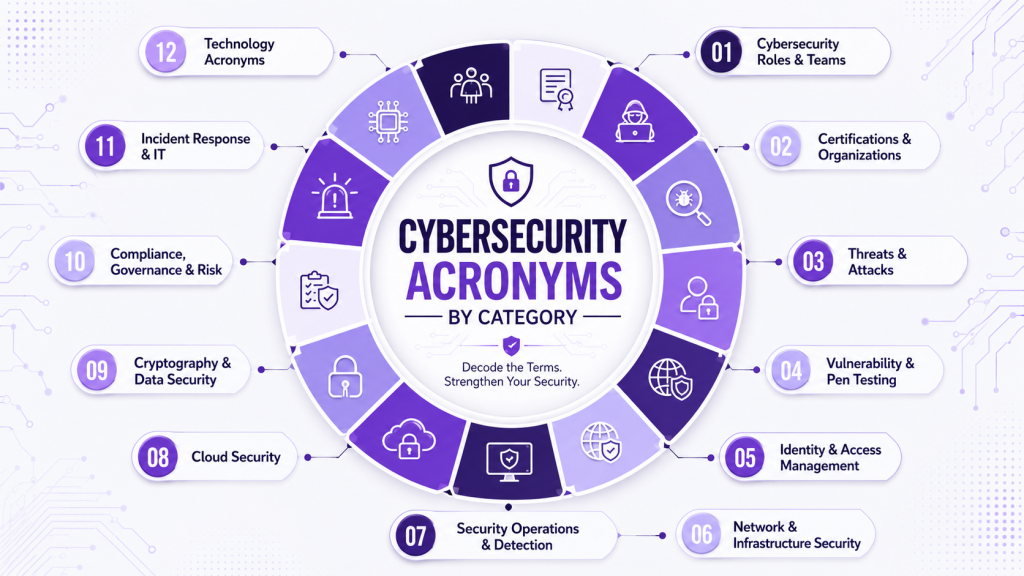
This list covers 124 cybersecurity acronyms across 10 categories: job titles, certifications, threats, vulnerability management, identity and access, network security, security operations, cloud security, cryptography, and compliance. Each entry includes the full form and a direct definition, reducing the need to search individual terms separately.
New acronyms enter the field as security technology develops. Categories such as cloud security (CNAPP, CSPM, CWPP) and zero trust (ZTNA, SSE, SASE) reflect terminology that expanded significantly in recent years, while foundational terms such as CIA (Confidentiality, Integrity, and Availability) and IAM remain constant across security programs. Bookmarking this cyber security acronyms list provides a single reference point for both categories going forward.
