

Understanding the scope of cybersecurity in Pakistan is essential because cybersecurity protects digital systems, networks, and data from cyber threats and attacks. In Pakistan, banks, telecom companies, IT firms, and public bodies are adopting digital systems. These sectors are becoming increasingly digitized and need protection.
This article examines the current cybersecurity landscape of Pakistan, spanning careers, education, industry demand, and government policy, to map out exactly where the opportunities and challenges lie.
What Is the Scope of Cybersecurity in Pakistan?
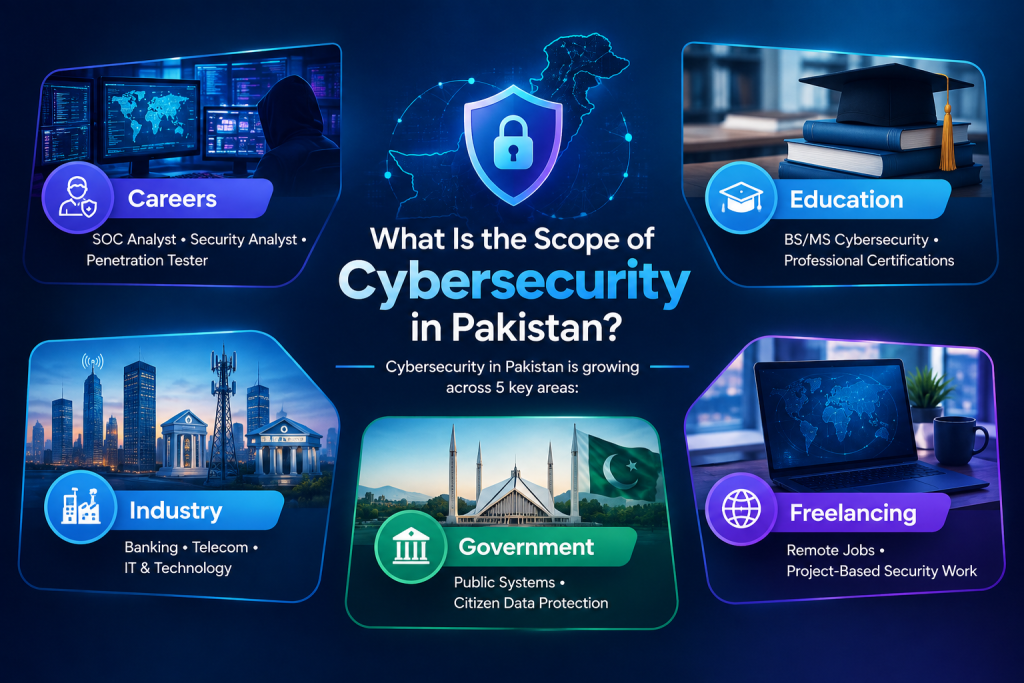
The scope of cybersecurity in Pakistan includes five areas:
- Careers: SOC analyst, security analyst, and penetration tester roles
- Education: BS Cybersecurity, MS Cybersecurity, and certification courses
- Industry: Banking, telecom, and IT sectors
- Government: Public systems and citizen data
- Freelancing: Remote and project-based security work
Why Is Demand for Cybersecurity Professionals Growing in Pakistan?
Demand for cybersecurity professionals in Pakistan is growing. Expanding digital systems and rising cyber threats drive this growth.
Key Drivers of Cybersecurity Demand
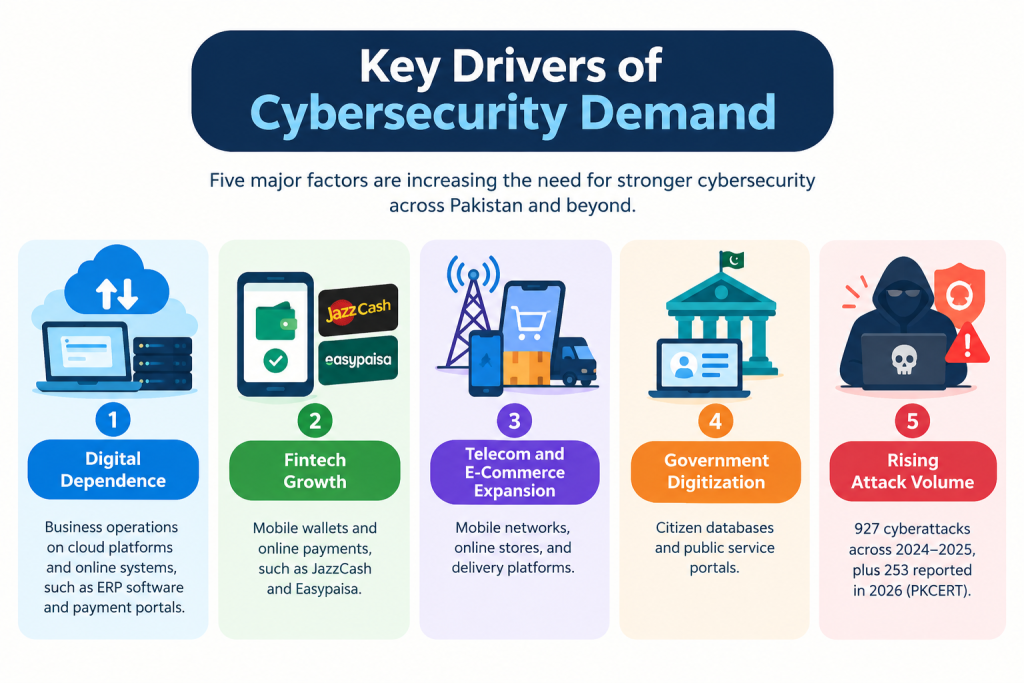
The five key factors driving this demand are:
- Digital Dependence
Business operations on cloud platforms and online systems, such as ERP software and payment portals
- Fintech Growth
Mobile wallets and online payments, such as JazzCash and Easypaisa
- Telecom and E-Commerce Expansion
Mobile networks, online stores, and delivery platforms
- Government Digitization
Citizen databases and public service portals
- Rising Attack Volume
927 cyberattacks across 2024–2025, plus 253 reported in 2026 (PKCERT)
Government Support for Cybersecurity in Pakistan
The State Bank of Pakistan is hiring Cybersecurity Specialists. These positions are in the Cybersecurity Department in Karachi. In 2024, the Government of Pakistan issued a financial sector cybersecurity advisory. It urges federal ministries, divisions, and the State Bank of Pakistan to adopt stronger security measures.
The Growing Cybersecurity Skills Gap in Pakistan
A 2022 Ignite report on the Digital Pakistan Cybersecurity Hackathon cites a global shortage of 3 to 4 million cybersecurity professionals. An Air University official told Arab News that a cybersecurity skills gap exists. This shortage is due to rapid technological advances and the scale of threats. More businesses now operate online, and every online system is a target!
Which Industries Hire Cybersecurity Professionals in Pakistan?
Banking, telecom, government, IT, healthcare, and e-commerce sectors hire cybersecurity professionals in Pakistan. These industries need protection of sensitive data and critical systems. Each industry has different security requirements:
| S.No | Industry | Security Requirements |
|---|---|---|
| 1 | Banking and Fintech | Fraud prevention, transaction security, and data protection |
| 2 | Telecom | Network security, privacy, and infrastructure protection |
| 3 | Government | Citizen data, public systems, and national infrastructure |
| 4 | IT and Software Houses | Application security, cloud security, and vulnerability management |
| 5 | Healthcare and E-commerce | Patient records and payment data |
What Cybersecurity Jobs Are Available in Pakistan?
The seven main cybersecurity roles and their core tasks in Pakistan are:
- SOC Analyst: Monitors security alerts and investigates suspicious activity
- Security Analyst: Assesses risks and maintains security controls
- Penetration Tester (Ethical Hacker): Simulates attacks to find exploitable weaknesses
- Network Security Engineer: Configures firewalls and secures network traffic
- Security Consultant: Advises organizations on security strategy and compliance
- Digital Forensics Analyst: Examines devices and logs to trace security breaches
- Incident Response Specialist: Contains and resolves active security incidents
What Job Can a Fresh Graduate Start With?
Junior SOC analyst and security analyst roles are the usual starting points. Careers progress from entry-level to mid-level to senior roles, such as junior SOC analyst, security engineer, and security architect. Roles can be on-site, hybrid, or remote. Some professionals work as freelancers on project-based security testing.
What Is the Scope of BS Cybersecurity in Pakistan?
BS Cybersecurity prepares graduates for technical security roles in public and private organizations. Common graduate roles include:
- Security Analyst
- Security Engineer
- Security Consultant
- Penetration Tester
The Higher Education Commission (HEC) has announced updated BS, MS, and Associate Degree curricula in Cybersecurity. These curricula will start in Fall 2026.
Is a BS in cybersecurity worth it? It gives students a structured path into information security roles.
What Are the Eligibility Requirements and Subjects for BS Cybersecurity?
Admissions in BS Cybersecurity require at least 50% marks in Intermediate (HSSC). Subject requirements vary by university. The University of the Punjab requires Mathematics. UITU accepts Pre-Engineering, Pre-Medical, Science General, and Computer Science. The minimum duration for the degree is four years.
Core subjects include:
- Network Security
- Cryptography
- Ethical Hacking
- Digital Forensics
- Risk Management
- Programming
How Much Do Cybersecurity Professionals Earn in Pakistan?
Glassdoor lists the median total pay for cybersecurity specialists in Pakistan at PKR 135,000 per month. The range extends from PKR 110,000 to PKR 198,000, as of September 2026.
Factors Affecting the Salary
The compensation depends on six factors:
- Role: SOC Analyst, Penetration Tester, or Security Engineer
- Experience Level: Entry-level, mid-level, or senior
- Employer Type: Banks, software houses, or multinational companies
- City: Karachi, Lahore, Islamabad, or Rawalpindi
- Certifications: Security+, CEH, or OSCP
- Work Mode: On-site, hybrid, remote, or freelance
Paylab reports that 10% of IT security specialists in Pakistan earn less than PKR 58,000 per month. 10% earn more than PKR 199,000.
Which Skills and Certifications Improve Cybersecurity Career Prospects in Pakistan?
Five core technical skills and certifications align with different career levels. These qualifications strengthen cybersecurity career prospects in Pakistan.
Technical Skills
These include:
- Networking: TCP/IP, firewalls, and network traffic analysis
- Linux: Command-line administration and server hardening
- Scripting: Python and Bash for security automation
- SIEM Tools: Log monitoring and alert analysis, using tools such as Splunk and Microsoft Sentinel
- Cloud Security: Protection of AWS, Azure, and Google Cloud environments
- Certifications: Five certifications cover the main career levels
| S.No | Certification | Level | Focus |
|---|---|---|---|
| 1 | Security+ | Entry | Core security fundamentals |
| 2 | CEH | Intermediate | Ethical hacking |
| 3 | OSCP | Advanced | Hands-on penetration testing |
| 4 | CISA | Intermediate | Information systems audit |
| 5 | CISSP | Senior | Security management and architecture |
CISSP requires 5 years of experience in at least 2 security domains.
Which certification comes first? Security+ is the common entry point. It is a vendor-neutral certification covering foundational security topics.
What Does the Future of Cybersecurity Look Like in Pakistan?
The future of cybersecurity in Pakistan centers on 4 trends:
- Cloud Security
Pakistan has devised a Cloud-First Policy. The banking sector is seeing growing adoption of hybrid cloud. This adoption increases the need for cloud security.
- AI-Driven Threat Detection
The government plans to use AI-based systems to protect critical infrastructure. These systems will monitor and respond to cyberattacks in real time.
- Security Operations Centers (SOCs)
PKCERT has given public and private organizations six months to establish operational SOCs.
- National Cyber Governance
The Cybersecurity Act 2025 establishes a National Cybersecurity Authority. The organization leads incident response and threat intelligence.
Growth faces 3 challenges:
- Limited practical skills
- Low security awareness
- Tight small-business budgets
What Else Do People Ask About Cybersecurity Scope in Pakistan?
Here are five common questions people have about cybersecurity in Pakistan.
Question 1: Is Cybersecurity a Good Career in Pakistan?
Answer: Yes. Cybersecurity includes seven core job roles across banking, telecom, IT, and government. Career outcomes depend on skills, experience, and employer.
Question 2: Can a Fresh Graduate Get a Cybersecurity Job in Pakistan?
Answer: Yes, fresh graduates can apply for entry-level roles. These roles include junior SOC analyst and security analyst. Certifications like Security+ can support their applications.
Question 3: Can Cybersecurity Professionals Work Remotely or Freelance from Pakistan?
Answer: Yes. Remote and freelance work is common in project-based services. These include penetration testing and vulnerability assessments.
Question 4: Do Cybersecurity Jobs Require Coding?
Answer: Coding requirements vary by role. Penetration testers and security engineers use scripting, such as Python and Bash. SOC analysts focus on alert analysis.
Question 5: Is BS Cybersecurity Better Than BS Computer Science?
Answer: The degrees differ in focus. BS Cybersecurity focuses on security subjects, such as cryptography and digital forensics. BS Computer Science covers broader computing topics, such as algorithms and software engineering.