
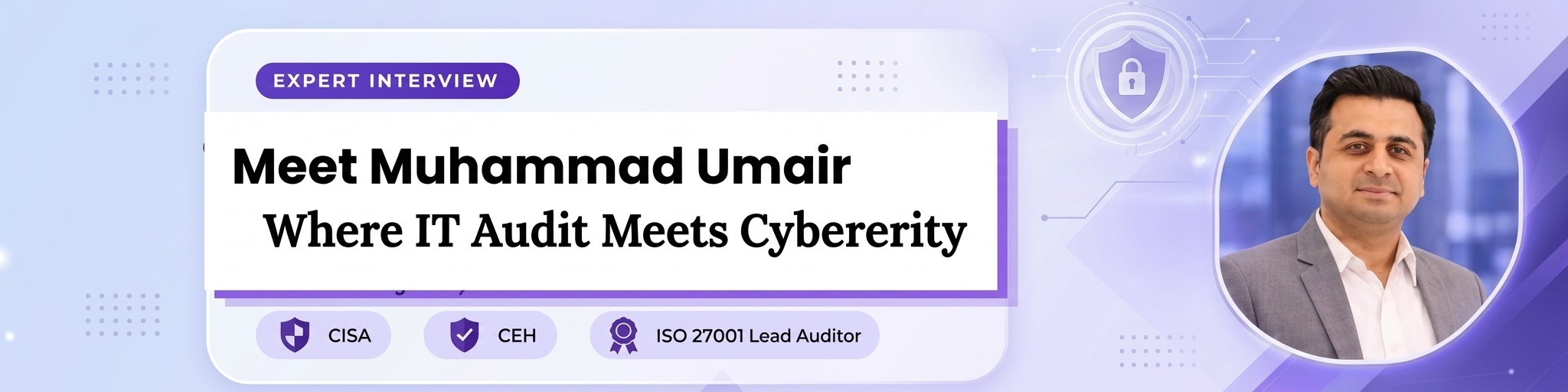
In banking, a single weak control can become a serious risk. Information Systems auditors catch those gaps before attackers or regulators do. Muhammad Umair Naveed is one of them. He is currently Unit Head, Digital System Audit at Bank Alfalah Limited in Karachi, where he manages IT risk assessments, leads audits of critical systems, and reviews cybersecurity controls. An experienced audit and security professional in the banking industry, he holds CISA, CEH, and ISO 27001 Lead Auditor credentials and is pursuing CRISC.
His path to this role spans banking and technology. He started as a Project Analyst at DWP Group, then moved into IS audit as an IS-Audit Officer at Bank Alfalah. After that he served as Senior Information Technology Auditor at United Bank Limited, then returned to Bank Alfalah to lead digital system audit. Along the way he built hands-on expertise in COBIT, NIST, and ISO 27001. A Master of Computer Science (MS) from Bahria University Karachi gave him a strong foundation in databases, networks, and programming. It lets him test what systems actually do, beyond what policies say.
In this interview with Apprise Cyber, Umair shares how he plans and prioritizes audits, evaluates banking systems, and keeps documentation audit-ready. He also talks about the projects, challenges, and lessons that shaped his career, and offers practical advice for anyone entering IT audit.
✳️ Professional Journey and Background
Apprise Cyber : Can you briefly describe your Information Systems Audit journey?
Muhammad Umair : I started my Information Systems Audit journey with IT controls. I also worked on compliance checks and risk assessments across various systems. Gradually, I gained hands-on experience with different frameworks and standards. Examples include COBIT and ISO standards.
Apprise Cyber: What motivated you to choose auditing and cybersecurity as your career path?
Muhammad Umair : My interest in cybersecurity and uncovering system vulnerabilities drove me toward auditing. This field combines investigation, technology, and protection of digital assets. I find it exciting.
Apprise Cyber : How has your computer science background helped shape your audit expertise?
Muhammad Umair : My computer science background has played a key role in developing my audit expertise. It gave me a strong foundation in databases, networks, and programming. This knowledge helped me understand technical systems more deeply during audits.
✳️ Roles and Responsibilities
Apprise Cyber: What are the main responsibilities of your current audit role?
Muhammad Umair : I manage IT risk assessments. I plan and lead audits of critical systems and review cybersecurity controls. I also ensure compliance with regulatory requirements.
Apprise Cyber : How do you ensure that audit processes stay in line with the latest IT governance standards?
Muhammad Umair : I align audit processes with frameworks and standards such as ETGRMF, COBIT, NIST, and ISO 27001. I regularly update procedures to reflect new IT governance trends and regulatory expectations.
Apprise Cyber : How do you maintain data confidentiality, integrity, and availability during audits?
Muhammad Umair : I maintain data confidentiality, integrity, and availability during audits. I use secure access controls and data encryption. I also follow strict audit protocols and documentation standards.
Apprise Cyber : How do you prioritize audit engagements in a fast-paced environment?
Muhammad Umair : I plan and prioritize audits based on:
- Risk level
- Regulatory deadlines
- System criticality
- Recent incidents
This approach helps allocate audit resources effectively.
✳️ Technical and Operational Expertise
Apprise Cyber : What methods do you use to evaluate IT controls and systems effectively?
Muhammad Umair : I use a combination of walkthroughs, control testing, configuration reviews, and interviews. I reference frameworks like COBIT and ISO standards to evaluate IT controls effectively.
Apprise Cyber: How do you audit critical banking systems, like applications or infrastructure?
Muhammad Umair : I usually begin with risk assessment. Then, I review system architecture and perform control testing. I also validate configurations and access rights for critical banking systems.
Apprise Cyber : How do you review documentation like IT policies and procedures before an audit?
Muhammad Umair : I review IT policies and procedures before fieldwork begins. I check them for completeness, alignment with standards, and practical implementation. I ensure they match actual practices.
Apprise Cyber : How do you assess the effectiveness of disaster recovery (DR) and backup controls?
Muhammad Umair : I assess DR and backup controls by reviewing DR plans and conducting backup restore tests. I also check RTO/RPO compliance and verify offsite storage and replication.
✳️ Security and Risk Management
Apprise Cyber : What role does risk assessment play in your audit planning process?
Muhammad Umair : Risk assessment plays a foundational role. It helps identify critical systems and evaluate inherent and residual risks. It also helps align audit efforts with identified risks. I use risk-scoring models, threat intelligence, and past audit trends. Such insights help me plan focused, efficient audit engagements.
Apprise Cyber : Can you describe how you conduct a regulatory or compliance-based IT audit?
Muhammad Umair : In regulatory IT audits, I start by mapping applicable laws or standards to IT controls. SBP guidelines and GDPR are examples of regulatory requirements. I perform technical validations such as log reviews, configuration checks, and access controls. I use these checks to assess compliance and document non-conformities with evidence.
Apprise Cyber : How do you identify and manage gaps in IT governance or security frameworks?
Muhammad Umair : I identify IT governance or security gaps through policy-to-practice validation. I also review frameworks like COBIT, NIST CSF, or ISO 27001. I conduct interviews, analyze logs, test technical safeguards, and highlight deviations. After that, I recommend actionable remediation plans with timelines.
✳️ Certifications and Learning
Apprise Cyber : How have your certifications like CISA and CEH helped you in your auditing work?
Muhammad Umair : CISA enhanced my understanding of audit methodologies, risk management, and IT governance. CEH strengthened my technical skills in identifying vulnerabilities, exploiting systems, and validating controls. These are critical for performing deep-dive audits.
Apprise Cyber : What certification or skill are you currently working toward, and why?
Muhammad Umair : I’m currently pursuing CRISC to deepen my expertise in IT risk management. It will help me understand how IT risk management aligns with business objectives. These skills are essential for high-impact audit planning and advisory roles.
Apprise Cyber : How do you stay updated on evolving cybersecurity and audit trends?
Muhammad Umair : I stay updated through webinars and publications from ISACA and SANS. I regularly check regulatory circulars (such as those issued by the SBP). I also follow security blogs and threat intelligence platforms. These insights help me align my audit approaches with emerging risks and technologies.
✳️ Projects and Tools
Apprise Cyber : Can you share an example of a past project where your analysis helped improve system controls?
Muhammad Umair : In a data center audit, I identified gaps in the firewall change management process. These gaps could have allowed unauthorized port openings. I coordinated with the network and InfoSec teams. Together, we introduced a formal approval workflow. I implemented change logging via the firewall management console. I also added quarterly rule base reviews. These controls reduced misconfigurations and improved audit readiness for regulatory inspections.
Apprise Cyber : What kind of audit tools or frameworks do you rely on during your assignments?
Muhammad Umair : E-Audit. An E-Audit tool is a centralized digital platform. It streamlines audit workflows, from planning and fieldwork to reporting and issue tracking. It supports evidence management, automated control testing, risk scoring, and real-time dashboards. Its key features include:
- Audit trail integrity
- Role-based access
- Integration with ITSM, GRC, and ERP systems
Apprise Cyber : How do you maintain documentation and audit trails while meeting professional standards?
Muhammad Umair : I maintain documentation and audit trails in encrypted, access-controlled repositories. These repositories have strict version control. I ensure each working paper includes:
- Control objectives
- Test steps
- Screenshots
- Logs
- Management responses
The documentation adheres to ISACA and internal QA standards. Such compliance ensures traceability from planning to issue closure. It also supports external audit and regulatory scrutiny.
✳️ Leadership and Team Development
AC: What strategies do you use to guide and train junior audit team members?
Muhammad Umair : I assign them to audits with increasing complexity. I provide the SOPs and control matrices. I also conduct post-audit debriefs to explain key findings. I mentor them on:
- Interpreting logs
- Reviewing configurations
- Aligning audit observations with frameworks like COBIT and SBP guidelines
Such guidance supports their technical growth and audit discipline.
Apprise Cyber: How do you ensure audit quality while managing multiple tasks or teams?
Muhammad Umair : I ensure quality by:
- Implementing a risk-based audit planning model
- Allocating resources based on complexity and team strengths
- Enforcing standard review cycles for managerial review and independent QA
I leverage automation in E-audit tools for workflow tracking. This approach ensures:
- Documentation quality
- Timely issue escalation
- Consistent adherence to regulatory and internal standards
✳️ Achievements and Reflections
Apprise Cyber : What has been one of your proudest moments or recognitions in your audit career?
Muhammad Umair : One of my proudest moments was leading a high-impact cybersecurity audit. I uncovered critical gaps in third-party connectivity. The audit resulted in executive-level recognition. It also led to a bank-wide revamp of the vendor risk management policy.
Apprise Cyber :What challenges have helped you grow the most professionally?
Muhammad Umair : Managing audits during a core banking system migration was a key challenge. It pushed me to adapt quickly to changing environments and understand complex integrations. It also helped me improve coordination between audit, IT, and InfoSec teams.
Apprise Cyber : What advice would you give to young professionals entering the IT audit field?
Muhammad Umair : Build a strong foundation in IT systems and frameworks like COBIT, ISO 27001, and NIST. Stay curious, ask questions, and always validate controls with evidence. Develop technical and communication skills to bridge gaps between IT and business effectively.
We thank Muhammad Umair Naveed for sharing his time and experience with us. His journey from Project Analyst to Unit Head, Digital System Audit shows what steady, hands-on work in IT audit can build.
Three lessons stand out from this interview:
- Start with risk. Every audit plan he described begins with risk level, regulatory deadlines, system criticality and recent incidents.
- Test the practice, not just the policy. Walkthroughs, configuration reviews and control testing show what systems actually do.
- Close the loop. A finding only matters when it ends in a fix, like the firewall approval workflow and quarterly rule-base reviews he put in place.
His advice to newcomers is simple: build a strong foundation in COBIT, ISO 27001 and NIST, stay curious, and always validate controls with evidence.
At Apprise Cyber, we hold the same standard. Our team supports ISO 27001 and other compliance work, risk assessments and penetration testing with the same evidence-first approach.