PKCERT compliance for TV channels is one of the most talked-about topics in Pakistan’s broadcast industry right now, and for good reason. If you run a satellite TV channel, you’ve probably heard the term thrown around in meetings without a clear explanation of what it actually means or what you’re supposed to do about it. So let’s clear that up in plain language.
In short: PKCERT compliance describes the cybersecurity measures Pakistani TV broadcasters are expected to adopt in 2026, following guidance shaped by National CERT and enforced through a formal directive from PEMRA, the broadcast regulator.
This guide walks through what triggered the requirement, what it actually asks of you, how it relates to the separate Pakistan Information Security Framework (PISF), and how a TV channel can achieve PKCERT compliance step by step, including where a cybersecurity partner like Apprise Cyber fits into the process.
What Does PKCERT Compliance Actually Mean for a TV Channel?
“PKCERT compliance” is a shorthand term, not a single official rulebook. Two different bodies are involved, and they play different roles.
- National CERT (also called Pakistan CERT, or nCERT) is Pakistan’s national cybersecurity body, formed on March 11, 2024, under the Cabinet Division . It briefed broadcasters on protocols, risk mitigation, and recommended measures such as third-party assessments and CISO appointments.
- PEMRA ( Pakistan Electronic Media Regulatory Authority) is the actual enforcer. It holds legal authority over TV licensees, and it’s PEMRA that issued the enforceable directive with a submission timeline and completion deadline .
National CERT also publishes the Pakistan Information Security Framework (PISF), a separate national cybersecurity framework with its own applicability rules , more on how that overlaps (and doesn’t) with PEMRA’s directive later on.
So when someone asks “what is PKCERT compliance for TV channels,” the honest answer is: it’s the broadcaster cybersecurity requirements shaped by National CERT’s guidance and made mandatory through PEMRA’s regulatory directive.
Why Are Pakistani TV Channels Being Asked to Comply Right Now?
PEMRA didn’t issue this directive out of nowhere. It followed a real incident, and the timeline moved fast:
- March 2026: Coordinated disruptions hit broadcasts at
Geo News, ARY News, and Samaa TV, with unauthorized messages appearing during transmission. The exact technical cause and the identity of those responsible were never publicly confirmed. A separate report also describes a March 12 incident affecting Khyber News, attributed differently, so more than one broadcaster-targeting incident may have occurred that month, with different reported attributions. - June 30, 2026: National CERT briefs broadcasters on cybersecurity protocols, risk mitigation strategies, and best practices for protecting broadcast infrastructure.
- July 8, 2026: PEMRA convenes a meeting in Islamabad on satellite uplink frequency interference, asking SUPARCO and Paksat International Limited to nominate technical experts.
- July 21, 2026: PEMRA formally directs all satellite TV channel licensees to submit a cybersecurity implementation roadmap within 3 working days.
- August 4, 2026: PEMRA’s deadline for broadcasters to complete the required cybersecurity measures.
What Are the Core Requirements Your TV Channel Must Meet?
PEMRA’s July 2026 notification names four specific measures for satellite TV licensees:
- A third-party cybersecurity audit or assessment, with a defined timeline submitted to PEMRA.
- SOC capability: either built in-house or run through managed security monitoring.
- A SIEM system, named specifically in PEMRA’s notification alongside SOC capability.
- A designated Chief Information Security Officer (CISO).
PEMRA also asked channels to name their Chief Technical Officers and required Chief Cyber Security Officers to attend compliance meetings, a sign that this is meant to be operational, not just a paperwork exercise.
Uplink and satellite interference sit alongside these cybersecurity measures too. PEMRA’s dedicated meeting with SUPARCO and Paksat International reflects a broader point: broadcast risk in 2026 covers two separate things, cyberattacks on IT systems, and interference with the satellite signal itself.
How Can a TV Channel Achieve PKCERT Compliance Step by Step?
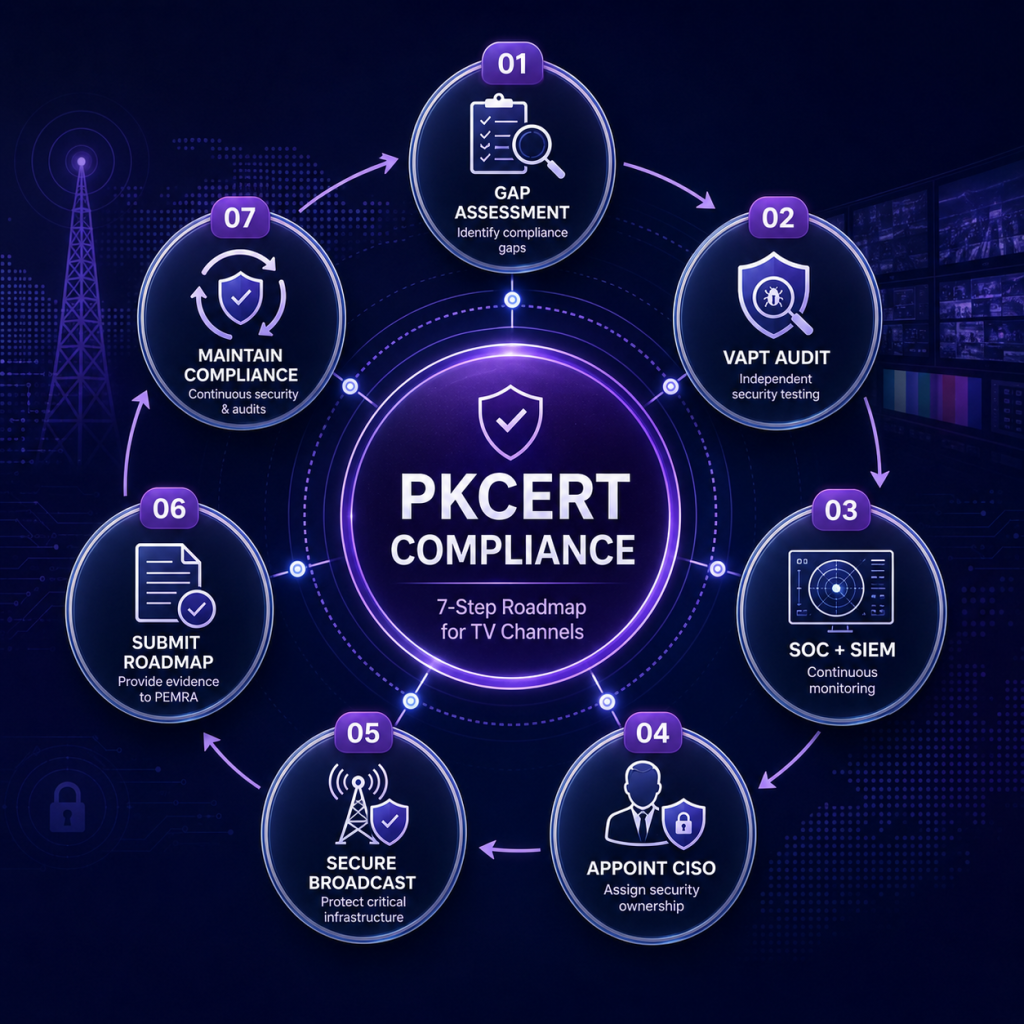
Think of this as your practical PKCERT compliance checklist. It mirrors the four required measures, plus the groundwork and follow-through that make them stick.
- Run an internal gap assessment.
Before bringing in outside help, identify where your channel already falls short, including monitoring, audit history, governance, and documentation. - Engage a third-party auditor for VAPT.
A vulnerability assessment and penetration testing engagement gives you an independent, documented view of your actual exposure, not a guess. - Stand up SOC and SIEM monitoring.
This can be built in-house or outsourced through managed security monitoring, depending on your team size and budget. - Appoint a CISO.
This can be a full-time hire or an outsourced/virtual CISO. PEMRA doesn’t mandate the staffing model, only that someone owns the program. - Secure your broadcast infrastructure.
This means the full stack: uplink security, playout system security, master control security, network segmentation, access control, multi-factor authentication, and encryption. - Submit your roadmap and documentation to PEMRA.
Your audit timeline, remediation plan, and compliance evidence all go into this submission. - Maintain ongoing compliance.
SOC, SIEM, and audit activity aren’t one-time boxes to tick; they’re meant to run continuously, especially following an active incident.
How Is PKCERT Compliance Different From PISF and PEMRA Requirements?
This is where a lot of confusion happens, so it’s worth being precise.
- PISF is published by National CERT. Its official applicability
section names four groups: federal and provincial government entities,
autonomous bodies, corporations, CERTs, and designated Critical Information
Infrastructure (CII). It does not name PEMRA-licensed
satellite TV broadcasters as a standalone category. - PEMRA’s directive is separate and broadcaster-specific.
The regulator issued it directly, in response to the March 2026 incidents,
with its own submission timeline and its own set of required measures.
What Happens During a Third-Party Cybersecurity Audit?
A third-party cybersecurity audit is exactly what it sounds like, an independent review conducted by an external firm, not a self-assessment. PEMRA’s directive requires broadcasters to submit a timeline for this audit as part of their roadmap.
These audits typically examine three areas:
- Network security across broadcast and corporate systems.
- Access controls, including who can reach critical systems and how.
- Incident response readiness: how quickly and effectively a channel could contain a future disruption.
Given that the March 2026 incidents affected live transmission at multiple broadcasters, it’s easy to see why these three areas are the focus. The standard output is a documented findings report paired with a remediation plan.
What Role Does Apprise Cyber Play in Helping TV Channels Meet PEMRA Cybersecurity Requirements?
Apprise Cyber supports Pakistani TV broadcasters across all four measures named in PEMRA’s directive:
- Audit requirement: Apprise Cyber conducts independent assessments and penetration testing of broadcast and corporate networks, then delivers the documented findings and remediation timeline that broadcasters submit to PEMRA.
- SOC and SIEM requirements: Apprise Cyber advises on in-house deployment or managed security monitoring, based on a channel’s existing IT team and budget.
- CISO requirement: Apprise Cyber supports the appointment requirement through outsourced or virtual CISO services, suited to broadcasters that need dedicated security leadership without a full in-house hire.
- Beyond the four core measures: Apprise Cyber also assists with the documentation PEMRA requires as part of roadmap submission, and with remediation planning that follows an audit’s findings.
If you’re evaluating us as a cybersecurity partner for this, we’d point you to the same three things: our experience with third-party audits, our track record with SOC and SIEM implementation, and our CISO advisory work. Those three map directly onto the areas PEMRA’s notification names, and they’re the areas we’d encourage any broadcaster to check before signing on with us or anyone else.
What Are the Risks of Not Complying?
Non-compliance exposes a TV channel to two categories of risk:
- Regulatory risk. PEMRA can enforce compliance through its laws, license terms, and directives, these apply to satellite licensees as a condition of operating.
- Operational risk. The March 2026 incidents already showed how a single event can disrupt live broadcasts at multiple major channels simultaneously.
It’s also worth noting that this isn’t unique to broadcasting. Pakistan’s cybersecurity regulation is spread across several sector regulators, the State Bank of Pakistan for financial institutions, the Pakistan Telecommunication Authority for telecom networks. PEMRA’s directive is simply the broadcast sector’s version of that same pattern.
Frequently Asked Questions
Question 1: Is PKCERT compliance mandatory for every TV channel?
Answer: PEMRA’s cybersecurity directive applies to all satellite television channel licensees, based on the official notification issued in July 2026.
Question 2: How long does it take to become compliant?
Answer: There’s no single fixed timeline for every channel, it depends on your starting point. PEMRA’s own deadline for completing key measures was August 4, 2026, but a full audit-to-remediation cycle can reasonably take several weeks depending on the scope of your infrastructure.
Question 3: Who inside a TV channel is responsible for compliance?
Answer: A designated CISO owns the compliance program. PEMRA’s directive also requires the Chief Technical Officer and Chief Cyber Security Officer to attend compliance meetings, which points to shared technical and security participation rather than one person carrying it alone.
Question 4: What if my channel missed the deadline? What should it do now?
Answer: Act on four fronts immediately: engage a third-party auditor, establish your SOC and SIEM arrangements, appoint a CISO, and submit documentation to PEMRA. The August 4, 2026 deadline has passed, but late action is still better than no action, especially given the regulatory and operational risk involved.